Introduction:

A former high school classmate and cherished old friend when reconnecting with Roger through Facebook quoted the old saying: "When God closes a door, he opens a window." The years have seen a number of life changes for us that make that adage ring true. After being blessed with good fortune, a wonderful son and great experiences, we decided to look out that window and prepare for more of what this wonderful life has to offer. We hope through our blog to share our journey from this point forward with family, with friends and with many others. Hopefully we'll make some new friends along the way. We hope you find our tales of some interest, even amusement and perhaps an inspiration for you to treat each and every day as an opportunity and an adventure to share with those who are an important part of your life.

Saturday, September 29, 2012

Meet an up and coming young Ecuadorian Artist!

The artist in a self portrait.
His name is Tomas Galindo Pazan.   He has a post graduate degree in architecture and that appears to be just one of his passions.  Just twenty-seven years old, he is an accomplished photographer and artist as well.  Both talents complement his chosen profession.  On top of everything else he is a poised, personable and genuinely likeable young man.

A typical Tomas Galindo Pazan
watercolor
Suzanne and I first encountered Tomas at one of the many art shows we attended after returning to Ecuador permanently.  We saw him at a number of shows thereafter.  He was well on his way to becoming renown for his vibrant, colorful watercolors.  The subject of most of his pieces was Galapagos wildlife and the pieces were interpretations of photography he took while visiting the Galapagos.  His photography alone is worthy of exhibition but his watercolors added a whole dimension to what his artist mind's eye saw on those islands.  You only had to mildly inquire to get him to explain his vision and he always did so with passion and devotion to his subject piece.

We nearly purchased a simply amazing watercolor of the infamous Galapagos blue-footed boobie (Suzanne has a fascination with these critters).  We have since discovered that no less than a half dozen of our friends were considering the same piece (yes, it has been sold!).  Tomas's work was rapidly becoming popular among the Cuenca ex-patriate community.

This oil painting was the
 Yazell's first purchase.

Our first purchase, however, was not a watercolor.  We had previously seen a single oil painting he had done.  It was a gorgeous piece but wasn't the right size and, at the time, our container (with some of our artwork from the states) had not arrived and we weren't sure yet what would go where in our new home.  (One of our friends, however, did purchase this oil!).  We both shared with Tomas that he had a talent for oil and a unique style and we hope he would venture more in that medium.

Fast forward a few weeks and there came the show (by this time, our container had arrived) when we made our first purchase.  It was an oil and not a watercolor.   It was a boobie  but not the blue-footed one (however, one of its notable cousins!) It now hangs proudly in Casa Yazell.


When Tomas delivered our first purchase, the conversation drifted to our love of wine.  By the time he left, Tomas was carrying two wine bottles but not for consumption.  One was an empty bottle. It was a Brunello Di Montalcino we had purchased during a trip to Tuscany and had kept cellared until opening it to celebrate Roger's retirement.  The other is a Brunello di Montalcino we brought to Ecuador with us that we plan to open on our 42nd anniversary later this year.  We had commissioned Tomas to paint another oil, this time with wine instead of wildlife as the subject matter. We ended up giving Tomas carte blanche for the creative style of the work. The only stipulations for the piece were that it had to contain those two bottles and at least one glass with wine .  We really didn't know what to expect.

Tomas making the delivery.

It was several weeks before we heard back from our young friend, but the call did come.  "I'm done,  said the voice on the other end of the phone, "but you have to wait a day or so for the paint to dry before I can bring the painting and give you your wine back!"  When he arrived, we were, indeed, pleased with the results


We now are the proud owners of two pieces by a very up and coming young Ecuadorian, Tomas Galindo Pazan.  Mark his name well.  He will either become very well known as a successful Ecuadorian architect or become renown as on of Ecuador's outstanding artists.   We would not be at all surprised if he accomplishes both!

This oil painting is currently being framed
and will hang in the sala of Casa Yazell
directly across from Roger's wine bar.

If you would like to see more of the work of this talented young man, go to 

www.flickr.com/photos/tomasgalindopazan/   

We think that after reviewing what you see, you'll agree that Tomas Galindo Pazan has talent!  We hope you enjoy his work as much as we do.  We are so very glad we had the opportunity to meet this young man during our travels, "juntos en camino de la vida".


Wednesday, September 12, 2012

San Miguel de Allende and Cuenca: making a choice between the two!

We are overdue for responding to a regular longtime reader who inquired back in July as to why we finally chose Cuenca, Ecuador for retirement over San Miguel Allende, Mexico.    Those of you who have been readers from the first, or who have discovered our entry on San Miguel in the archives, know that we originally planned on retiring to this community in the central highlands of Mexico.

Residential suburbs of Cuenca, Ecuador
Residential suburbs of San Miguel de Allende, Mexico
 That reader wrote and inquired as to what tipped the scale in Ecuador's favor?  We thought it was a good and a fair question, so we promised to explore the reasons more fully in a blog.  (At this point, if you haven't read:  "A Look At San Miguel de Allende " originally posted on April 21, 2011, it may be of benefit to do so before going further on this blog.)

Street scene in historico centro Cuenca

Street scene in historico centro
San Miguel de Allende

Both cities have some desirable attributes in common.  Both have historic central districts that are designated as UNESCO World Heritage Sites.  Both have beautiful centrally located plazas that are  anchors for many community activities and resources.  Both have an abundance of colorful colonial architecture.  Both are blessed with an abundance of beautiful churches and cathedrals.  Both have active city administrations that support art and cultural activities for the benefit of their citizenry.  Both have established ex-patriate residents that have integrated well through many parts of the city. Both represent well their heritage and culture. Both have generally moderate climates year around. These were among the attributes that were important to us as we sought an appropriate locale for ex-patriate retirement living and both cities appeared to have much to offer us as future ex-patriates.

Parroquia San Miguel in San Miguel de Allende

Iglesia San Francisco in Cuenca
So what were the differences?  And what among these differences finally led us to choose Cuenca after having invested several exploration trips to Mexico?  Here were some of the key factors that tipped the scale in Cuenca's favor:

Residency status:   The process of applying for and obtaining residency status in Mexico appears to be simpler and less intensive than it is here in Ecuador (Our best advice on both: you really need to DO your complete homework BEFORE you come!).   However, once residency status is granted, there is some advantage to a residency in Ecuador.  That lies in the simple fact that permanent foreign residents of Ecuador are granted the same protections as Ecuadorian citizens under the Ecuadorian constitution.  In Ecuador, as permanent residents, we can, (with some conditions and limitations) work at most occupations, apply for special benefits and enjoy the same usage of public facilities as citizens.  That is not so in Mexico, which is much more legally restrictive as to the rights, privileges and opportunities granted to permanent foreign residents. 

Health care:    Health care in Mexico is highly variable by locale and while excellent in some locales (such as metropolitan Guadalajara), it is often limited and more costly in semi-rural areas such as San Miguel.  In Cuenca, there are numerous facilities, a plethora of accessible well-trained physicians and it is generally more affordable.

Superstructure and public transportation:   Cuenca is significantly larger than San Miguel (500,000+ metro versus less than 100,000) so it has a larger tax base and has some developed amenities and superstructure not found in San Miguel.  The area outlying the historico centro has modern amenities in dining, culture, shopping, health care facilities, etc.  Cuenca's tax base supports a more thoroughly developed and better maintained street system, public mass transit.  There are plans for developing light rail.  It is not readily apparent but the presence of several universities in Cuenca add significantly to the the activities and resources available to residents of the community.

Currency:  Ecuador's official currency is the U.S. dollar. While that creates some economic challenges for the country as a whole, it is a superb convenience to us ex-patriates not to have worry about currency exchange and conversion. It really does simplify every day living and budgeting as well transferring funds.

Acceptance and welcome:   While San Miguel de Allende has a long history of having an ex-patriate presence (there has been significant migration to San Miguel since the late 40's) and while there is some superb integration and acceptance of ex-pats into its social structure and community organizations, Mexico, as a nation, still has an undercurrent of tension with its neighbors to the north.  While there is less of that in the state of Guanajuato than anyplace else in Mexico, we found the genuine welcome and acceptance of Cuencanos to our arrival and efforts toward residency far in excess of anything we had ever experienced in Mexico.  Moreover, the welcome and acceptance by fellow ex-patriates who had preceded us contained more good affinity here in Ecuador than what was evident anywhere in Mexico.

Greater affordability:   Some select everyday living expenses were cheaper for us in Mexico and despite San Miguel's much smaller size as a city, there was more availability of products and brands "from back home" than we find here in Cuenca.  However, real estate and housing were a much different story.  Housing costs in outlying neighborhoods in San Miguel were only fractionally lower than back in Arizona. In the historico centro, those costs far exceeded the costs of a typical suburban Phoenix home.   Overall, Cuenca offered a "bigger bang for our buck" despite being one of the more costly areas in Ecuador and despite Ecuador's high tariffs on imports.  It will, however, require some adjustment in lifestyle choices and purchase decisions.

Potential for Violence:   The central highlands of Mexico have not been beset with the much publicized drug cartel violence you hear about in the states.  However, over the past four years, that violence, while not having extended itself yet to the San Miguel-Guanajuato area has appeared in other places where it was previously not in evidence (such as the Chapala area).  The ongoing struggle between the government and the cartels and among the the cartels themselves are destabilizing Mexican society as a whole.  Ecuador, on the other hand has recently emerged from an extended period of economic and political instability and seems to be entering a period in which social stability and growth seem to on the upswing and headed for a steadily progressing trend.   Cuenca, in particular, appears to be trending toward a growing, emerging middle class and has become a magnet not just for ex-patriates but also for returning, upwardly mobile Ecuadorians in search of a better life and economic opportunity.  Both areas share common challenges on petty social crime, as do most developing countries with a broad economic disparity. That, unfortunately, is an issue an ex-patriate must be prepared to face and willing to address wherever he chooses to reside.

A rainbow in the Cajas mountains as seen from our house.
Environmental Diversity:  Both areas are beautiful in their own ways.  Ecuador, however, packs more geological and biological diversity into every square mile than any other country on Earth.  There simply aren't enough words to adequately describe the myriad opportunities, all within a few hours commute, to enjoy the spectacular beauty of this country.  Ecuador is roughly the size of the state of Nevada but presents more geological terrains and venues and offers more species of flora and fauna than all of North America put together.  It offers us more opportunities to enjoy new adventures right in our own backyard than almost anyplace else we could have chosen to retire to.

Cuenca, Ecuador's Historico Centro

Central location:  We resided in Phoenix and our grown son resides in Atlanta.  It was about a four hour plane ride apart.   Atlanta to Ecuador falls within the four and a half to five hour range, almost virtually the same.   In addition, we are less than six hours access, not only to most of the US, Central America and Carribean, but to nearly all of the places we hope to visit in South America, as well.  One of our goals was affordable living that would allow us to continue to enjoy vacations of travel and exploration in our retirement.  Ecuador's easy access to so many destinations (including direct flights to Spain) and the discount fares available to a "tercera edad" resident of Ecuador make that goal readily attainable.

Roger & Suzanne in Cuenca
Hopefully, our answer to one reader's inquiry provided the answers they were seeking and provided some helpful insight to others, as well.  We do still have a fond spot in our hearts for central Mexico as a wonderful place to visit and/or reside.  It may well be the right choice for many and would not have been an undesirable choice for us.  It will, most certainly, be a city we will look forward to making repeat visits to.  Fortunately, it will be easy to so from our chosen home here in Cuenca.  We look forward to a lot of adventures originating from our new home and we feel both fortunate and blessed as we continue ever onward, "juntos en el camino de la vida"!

Thursday, August 23, 2012

A Great Little Getaway...just what we needed!


 "It's pretty, but there's not a lot to do in Vilcabamaba", one of our Xpadorian friends told us.  "But you will see a lot of interesting people."  Actually, the prospect of hanging out in a quiet rural area with drop dead gorgeous scenery, eating good food, sipping a little wine, plus meeting interesting people from all over the world sounded like just the therapy we've been needing.  The past six months has been filled with returning to Ecuador, getting our temporary visa, getting our residency visa, getting our cedula, opening a bank account, buying a house, doing some remodeling, getting our container here, unpacking said container,  buying a security system for the house, etc. etc. etc. and so forth!   Whew!  who knew retiring could be such hard work!!!!!

The gate to the Loja centro, built mostly as a tourist attraction.
 Our van from Cuenca had its depot near here.
 So the day before Suzanne's birthday, we boarded the Elite Tours transport van to Loja,  capital of the province of the same name that lies just south of Azuay.  Three and a half hours later we were there and commandeered a driver for the one hour drive south to beautiful, gorgeous Vilcabamba, known as "the valley of longevity".  On the outskirts, nestled on a high ridge sat the resort of Izychaluma ( Izychaluma in the local indigenous dialect means "two hills").  The scenery was gorgeous, our nice private cabin was nestled along a rock walkway with a back deck complete with comfortable hammock and a view!  It had all the makings of a great 4-day retreat! It didn't disappoint us as the following photos will show:


It takes about an hour to get from Loja to Vilcabamba.  There were some washouts on
this mountainous trek during the rainy season so there is a lot of roadwork.  There is
 also a road being rebuilt south to Peru.  We were glad we hired a driver who knew the way.

Descending into the valley where we retreated for 4 days
from the cold and the "hectic" pace of life we had been leading in Cuenca.

Our cabin at Izychaluma Resort

Suzanne at the cabin
View from the cabin's back deck.


It didn't take long to make good use of the hammock! With Suzanne is
"Shotzie", one of our many stuffed bears.  One always travels with us on trips!

Looking downhill into Vilcabamaba centro from the resort.
Hosteria Izychaluma is owned and operated by two German brothers and offers a variety of different accommodations including dormitory rooms that are popular with backpackers.  We met guests from seven different countries during our stay.  One staff member spoke at least four different languages (we overheard her speaking to guests in Spanish, English, French, and German).  The town of Vilcabamba itself is very clean despite some major road renovation going on. It is quiet, laid back and filled with gracious people all seemingly bent on having a wonderful day.  We certainly did!

A town square park is the focal point of Vilcabamba


Downtown is neat, clean, with some nice sidewalk cafes ideal for sitting,
seeing the world go by and being seen.

A stylish church on the square.

It only took about 20-25 minutes to walk to the centro from the resort. It was roughly about 2 kilometers (a downhill mile and a quarter for you Arizona folks).  We treated ourselves to cab ride back (living in the Andes, you learn to do your walking downhill and save your riding for uphill portions of your day!)
Interestingly, all the local taxis in Vilcabamba were 4-wheel drive vehicles!


There are also accommodations in town. Just a block off the square is
Jardins Escondido (Hidden Gardens), a hosteria and also a pretty decent
spot to have a Mexican luncheon.
Leave it to the Ecuadorian Wine Guy to discover a wine emporium just
after arriving in the centro.  Some mixed reviews on our discoveries there.
Roger will be posting those reviews this coming weekend on "Roger's Grapevine"
(www.rogersgrapevine.blogspot.com)
The resort had nice affordable wines and a nice menu selection so we ate all but one meal on site (breakfast was included in the price of our accommodation).  We hiked, played cards and dominos.  Suzanne got acquainted with several of the resident pets (one new kitten in particular!) and we polished off our last afternoon with relaxing massages.  Our getaway was just what the doctor ordered!

Suzanne and one of her new friends!

Roger enjoyed the grounds as well as the wine!


View from the dining room on our last morning!


We saw this mural during a few hours spent in Loja before our return to Cuenca.

We took time for a stint of sightseeing, a little pottery shopping and an"almuerzo" in Loja before climbing into the van for our return trek to Cuenca.  We arrived back in town, glad to be back at "Casa Yazell" but filled with warm (both literally and figuratively) memories of our Vilcabama getaway.   

It was good, as always, to be "juntos en el camino de la vida".


Saturday, August 11, 2012

Cuenca Wine Guy Bulletin para once de Agosto!


For my ex-patriate friends in Cuenca who really miss their California Zinfandel, here's a special wine bulletin:   I saw Bogle Old Vine Zinfandel on the shelves at Super Maxi El Vergel this Saturday.  Granted it was at roughly twice the retail ($28) you probably would have paid in the US of A but then again it is the first spotting of either a Zinfandel or Primitivo I've ever made in Ecuador (including some extensive restaurant wine list reading) and if you've been in severe Zinfandel withdrawal, it might be worth the splurge to you.

Thought you would like to know....Sainte!

Friday, August 10, 2012

Vino de Monastario del Carmen de la Asuncion

A recent Cuenca wine purchase.
An order of Discalced Carmelite Nuns has existed in Cuenca since 1682.  By 1730, the order's monastery was part of a complex that included the Sanctuario Mariano, a beautiful white baroque church nearly adjacent to the Nuevo Catedral in Cuenca and home of a very popular flower market on the plaza in front.  In the corner is a lobby where the cloistered nuns have non visual interaction with the public via a turnstile where they vend among other things, soap, dulce de leche and wine.

Our Lady of Mount Carmel
The wine is a traditional vino de consagrar and has been approved for use as a sacramental wine by the archbishop of Cuenca.  Vino de Consegrar by traditional and church regulation utilizes concentrated must of white grapes and then is aged in large oak barrels.  Concentrated grape must is the unfiltered squeezings that comes from the crushing of grapes to produce juice.  Being produced from must insures a high concentration of sugars so it is a very sweet wine.  This aging imparts a golden bronze coloration and concentration of flavors giving most of these wines a rich fig and raisin aroma and flavor.  While many must-produced wines are often in single digits for alcohol content,  Vina Florida offered by the Carmelite Sisters of Cuenca comes in at 11%.  That's not particularly high for wine, but the combination of double digit alcohol content with a good deal of residual sugar can lead to a pretty rapid "buzz" if consumed too quickly.  Because your body burns sugar first, then later metabolizes alcohol, the combination of the two together will simply lead to a quicker concentration of blood alcohol content.
Santuario Mariano in Cuenca
Photo courtesy of Rich and Nancy's blog:
www.richandnancy.blogspot.com

Recently Vina Florida has become available at retail here in Cuenca. (The Wine Guy secured his at the Co-opera).  It's at a higher price than what you will pay through the vendor turnstile at the Monasterio del Carmen de la Ascuncion but it is still affordable, particularly by Ecuadorian standards.   If you are looking for a sweet treat to sip at sunset or to share with your dinner guests,  you may want to try a bottle of Vina Florida. It may satisfy those who have moved here and miss their former availability of late harvest wines.

While Suzanne and I normally prefer bold, dry red wine wines, we did enjoy straying over to the sweeter side in trying this locally available wine.   It never hurts to try something new when you are traveling "juntos en el camino de la vida".

Tuesday, August 7, 2012

Ladies Who Lunch!

The Plaza in Chordeleg, Ecuador
Suzanne and some friends have formed an informal group in Cuenca.   They call themselves "Ladies who lunch and shop!"   Boy,  do they know how to do both of those!  It started out as an innocent monthly get together over lunch.  Each month, someone different in the group would pick a venue and send out invitations to the group and those who could attend would respond.  The group of ladies would get together, enjoy a meal at one of Cuenca's better restaurants and share the latest news, gossip and tips on adjusting to ex-patriate life.  What a great escape and a wonderful idea for  adjusting to life in a foreign land!
The artistic fountain in the Chordeleg Plaza


This past week, however, the ladies took it up a notch further.  They commandeered a Mercedes Benz van, private driver and scheduled a special trip for fifteen (the van's capacity...it turned out they could have scheduled two vans based on the number of interested participants) to Chordeleg, the filigree silver jewelry capital of Azuay province (and probably Ecuador,  if not South America).   Chordeleg is  roughly 1.5 to 2 hours down the road from Cuenca. The excursion allowed the ladies a full  three hours of shopping in Chordeleg and then included a slight detour on the route back to Cuenca for lunch at the Hosteria Uzhupud in Paute.  This resort offers a fabulous setting and superb dining..  A great time was had by all!


The folks in the US have the Red Hat Ladies but they don't hold a candle to "The Ex-Patriate Ladies who Lunch and Shop" of Cuenca, Ecuador.
Suzanne (front-left) and "The Ladies Who Lunch and Shop"
enjoying themselves in Paute, Ecuador

Suzanne enjoyed her special excursion with friends (Roger meanwhile took a nap and painted the front courtyard wall).  So went another day in retirement as we continue our journey:  "juntos en el camino de la vida."

Sunday, July 22, 2012

A Little Excitement in The Hood!

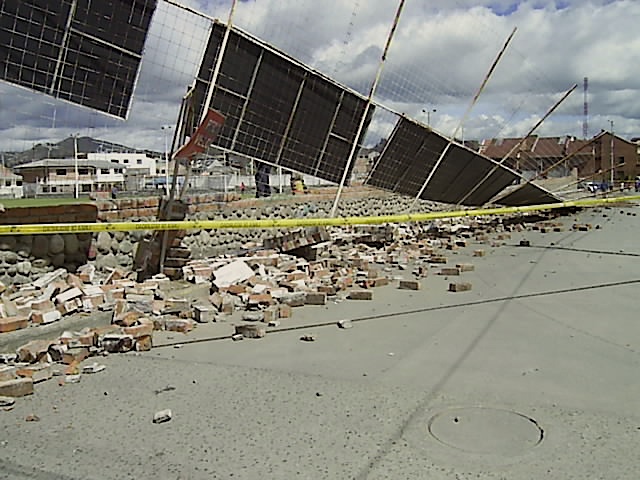
The west wall of the Estadio Cashapata
wound up in the street Sunday afternoon
"Joshua fit the battle of Jericho and the walls came tumbling down!"

O.K. it wasn't quite a biblical event even though it was Sunday afternoon but we did have some tumbling walls in our neighborhood this weekend.

We Yazells live about a long city block block away from the Estadio Cashapata which is a futbol (soccer to you norte americanos!) stadium housing the Club Liga de Cuenca.  It is surrounded by a 3 meter wall (9-10 ft) on top of which there is a chain link fence of about 2 meters (6-7ft).  On one side (west) the fence holds advertising signage.

A friend of ours lives in an edifico departmentos (condominium apartment building) about three blocks away and regularly comes walking her dog on our street.  Sunday afternoon, she calls after returning from her daily walk and asks if we've looked out our window toward the stadium (our house is on a curve so the upstairs window looks down the street with a clear view of the stadium's west wall!).  We looked and to our surprise  we saw a clear view of the field!

The entire street on the west side
of the estadio was blocked!
It seems the high westerly winds we had experienced during the day had caught the metal signage on the fence and proceeded to topple the fence and the upper portion of the wall with it filling the street on the west side of the estadio.  We, of course, had to walk down and take some photos.

Normally you have be inside to
see the play going on  at the estadio!


For the rest of the afternoon, our typically quiet dead end street was active with cars attempting to find a new route around the estadio only to discover there was no way out on Calle Eloy Abad (our street).

Workmen begin work on removing the signage from the fence.


The fence and signage got cleared by sunset
 but the bricks and debris won't be
out of the street until sometime Monday.

Roger, who was working that afternoon on clearing some overgrown brush on the lot next to our wall even got to talk with the policia who came by wondering if traffic could be re-routed through our neighborhood.  


Roger doing some clean up work on
what should have been
a very quiet Sunday afternoon!

Typically the neighborhood Ecua-volley game is the only neighborhood activity we get on Sunday afternoons...today there was a little more going on.  It made for a little extra excitement as we continue our retirement journey:  "juntos en el camino de la vida".

Friday, July 20, 2012

Time for more picks from The Wine Guy!

The Wine Guy

OK, we took time off from the hectic schedule of retiring (Boy...who knew that was going to be such hard work!!!) and headed to the coast for much needed R&R.  We shared some wonderful time with five close friends and got to do some beach combing and whale watching.  We'll share some coastal observations (and photos) later on in the week ahead.

Anyway, it's been a while since we made some wine recommendations, so here are three red and one white wine purchases that The Wine Guy has made and enjoyed recently here in Cuenca.  A couple of these wines have been reviewed in further detail on Roger's wine blog: www.rogersgrapevine.blogspot.com.


The wines are:

San Felipe Roble Malbec:  a nice smooth Argentinean Malbec with a long lingering finish.  I was lucky enough to find an older vintage (2005) and it had aged quite nicely.

Miguel Torres Santa Digna Cabernet Sauvignon Reserva:  Some great cabernets have been coming out of Chile and Argentina and for us in Ecuador, they make a more affordable alternative to the highly taxed imports from Napa Valley and Washington that we were used to in the states.  The Torres family are great worldwide winemakers in addition to being Spain (and one of Europe's) leading winemaking family.

Montes Limited Selection Cabernet Sauvignon/Carmenere:  Carmenere has become Chile's signature wine grape for the simple reason that it grows so uniquely well there and the Chileans have learned how to make great use of it.  In this case, that great use is in rounding out an excellent cabernet sauvignon.

Santa Julia Fuzion:  A very nice white wine blend that adds Chenin Blanc to Chardonnay.  Try this refreshing white well-chilled with some grilled langostinos and you've got a real treat!

Hope you find these worth exploring.  I would welcome input from any of my Ecuadorian friends and readers on your wine discoveries here in the land South of Zero.  Email rogerthewineguy@gmail.com.

Sunday, July 8, 2012

At Last...A Courtyard!

 Long time readers of our blog (or those who've explored the archives) are probably aware that the Yazells originally planned to retire to the central highlands of Mexico.  As twelve year residents of Arizona, we had many opportunities to visit, explore and fall in love with the culture and architecture of Mexico.   Also, as homeowners in a land replete with sunshine, we had come to appreciate the mixing of indoor conveniences and lifestyles in a semi outdoor setting.  We always thought that the ideal home would offer us the opportunity to create an open courtyard accessible from the main living/dining/working areas of the house.  Our new home in Ecuador offered us an opportunity to bring that dream to a reality.  As the realtor took us through a prospective house and bought us through the dining/kitchen area out to a plain and simple rear courtyard containing an Ecuadorian laundry and calaphon, Suzanne turned to me and pointed to the middle of the back wall and said "We can fit our chiminea very well here, don't you think?"  My reply was "Oh yea and won't our tile murals look great on these walls?"


This is what the back courtyard looked like when
we  first purchased our new home in Ecuador


Within a week of our closing, our architect-friend Marcello was looking over a photo of a chiminea on our laptop and we were sketching our thoughts on how we wanted this space in the rear to be developed.   Chimineas are, at best, uncommon here.  The fact was that Marcello had never designed one nor had his crew ever built one.  But he thought our idea was great so less than two weeks after that, we were cutting into the rear wall, inserting some rebar and getting ready to pour a semi-circle of concrete on a handmade elevated platform and mold.   Project Casa Yazell Courtyard was underway!


Here's a very brief photo journal of what transpired over the next several weeks:


After the concrete platform dried,
the masonry work began in earnest!


Adding the support base would enable the temporary
 table frame and support platform to be removed.
The space underneath would accessible from one side and
used for firewood storage.

Marco and his helper add the cement finish.
After that cured, there would be hand cut stone for the base.
We also had some shelves added to hold some of Suzanne's favorite Tonala pottery pieces.


The finished Chiminea as it is now seen from our guest bedroom.
A nice piece of first time work by our architect and his crew!


After our container arrived, the finishing touches were added.
Viva la courtyard!


Naturally we have to have a grill! (It came on our container)
 The window behind the grill is where our kitchen is.
Note the hummingbird feeder...we have guests every day!


Although the chiminea was the major piece of construction, there was also some other work involved.  We removed the Ecuadorian laundry sink, built a small wall, added cabinetry to enclose the calaphon and propane tanks.  Roger installed some ceramic light fixtures to replace bare bulbs, ran gas line extensions to our indoor laundry and for the gas grill.  The entire courtyard also got some fresh paint and an electric fence was installed on the top of the wall for security.  After the container arrival, it was also quite a chore to mount our tiles on the concrete walls.   We got it all done, added some plants including a wall mounted orchid (a housewarming gift from local friends).  The storage area under the chiminea now regularly holds two to three bundles of well dried Ecualyptus for firewood and our courtyard is utilized almost every day!


The courtyard even has a breakfast nook we enjoy almost every morning!
.  The simple wooden table and chairs was our sole dining furniture 
for weeks while we awaited our container arrival.


From an early morning coffee and a breakfast that includes hummingbird guests to a late evening glass of wine in front of the roaring fire, the courtyard at Casa Yazell has become one of our favorite places to be.  It's yet another dream come true as we continue "juntos en el camino de la vida!"

Tuesday, June 26, 2012

Decanza en paz, Solitario Jorge!

Photo of Lonesome George is from the Ecuador & Galapagos Facebook page
The big news this week out of the land south of zero didn't have anything to do with visas, shipping containers, ex pats finding real estate or the changes in Ecuadorian bureaucracy.   It had to do with the passing of a presumed 100 year old giant turtle known as "Lonesome George".   George is one of about 20,000 giant tortoises that were current inhabitants of Ecuador's Galapagos islands, made famous through Charles Darwin's "Evolution of Species".

George was unique, however, among those 20,000 because he was the only one of his type....the sole survivor of a special subspecies of giant tortoise.  As such he became a symbol for conservation and biodiversity and of the Ecuadorian reverence for the abundant fauna and flora that exists here.

For those readers who aren't aware: Ecuador has more species of flora and fauna than any other single nation on earth.  It is also the only country on earth that has written special rights into its constitution for nature and the environment.  "Lonesome George" was more than just a tourist celebrity....he was a national symbol of the pride Ecuadorians feel about their country and the connection each Ecuadorian has to Nature.

"Lonesome George's name came about not only because he was the last of his kind but also because he was a bit of an individualist.  For many years , his keepers on the Galapagos had attempted pairing George with mates of of other subspecies of giant tortoise but he showed virtually no interest.  Only one mating was noted over years of effort but that, unfortunately, did not result in fertilized eggs.  George, unlike most of the wildlife on the Galapagos, also persistently avoided human contact when given the chance, with the sole exception of his keeper of nearly 4 decades.  He was, in fact, and in practice, a solitary individual.

George was found dead somewhat unexpectedly...giant tortoises, after all, are know to live up to 200 years.  However, given the fact that he is the only one of his subspecies that  modern zoologists have ever known, his estimated age and relation to lifespan may be speculative.

All we do know is that this treasured national symbol of the biodiversity is gone and will be sorely missed by all who treasure and cherish this land and what it has to offer.

So many people from all over the world have come to know the story of George that the national park officials have decided to create a special memorial album commemorating George's life.  If you were fortunate enough to visit the Galapagos and see and photograph George, you are encouraged to submit a remembrance email and your photograph for consideration as an addition to the memorial album.  Send your submission to aduenas@turismo.gob.ec.  You can find more details and even read some of the submissions  on the Ecuador & Galapagos Facebook page.

Decanza en paz (rest in peace) Solitario Jorge....you will will be missed and you will be remembered so long as there is an Ecuador!