Introduction:

A former high school classmate and cherished old friend when reconnecting with Roger through Facebook quoted the old saying: "When God closes a door, he opens a window." The years have seen a number of life changes for us that make that adage ring true. After being blessed with good fortune, a wonderful son and great experiences, we decided to look out that window and prepare for more of what this wonderful life has to offer. We hope through our blog to share our journey from this point forward with family, with friends and with many others. Hopefully we'll make some new friends along the way. We hope you find our tales of some interest, even amusement and perhaps an inspiration for you to treat each and every day as an opportunity and an adventure to share with those who are an important part of your life.

Thursday, November 24, 2011

Paperwork Seems Never Ending Part II: "There's a light at the end of the tunnel!"

For the Yazells, The Phoenix Ecuadorian Consulate Office
was the light at end of a very long tunnel! 
Good news:  there's a light at the end of the tunnel.

More good news: it's not an oncoming train.

Those statements reflect some of the emotion of the past few weeks in getting our paperwork together.  It's been a real roller coaster ride as it probably has been for most people going through this experience.  We can't emphasize enough:  do your homework, research as much as you, ask questions and when you think you have all the answers, start the process all over again.  Just when you think you've got it down pat is usually when you discover...ooops, here's something we didn't know or here's something we misinterpreted or here's something new that we simply didn't uncover.  I'm sure it's happened to just about everyone whose gone through this process.

Let's begin by correcting a couple of miscues from our previous blog where we listed the necessary items for the 12-IX and 9-I visa:

I mentioned that the we were using the social security benefit statement to cover the financial security requirement for the 12-IX......WRONG.....we needed a current bank statement showing access to enough funds to support us during the term of our visa...thank goodness we found that out before we came to the consulate for our final visit and application approval process (again you can't ask too many questions and the only stupid question is the one you FAIL to ask!)

The other erroneous item in the previous blog concerned our process for the 9-I.  I mentioned we had to get notarized legalized color copies of passports from the consulate to send to attorneys in Ecuador.   WRONG again...the consulate office here does not do that.  Those color copies have to be legalized IN Ecuador.  We will be sending color copies of the first two pages of passports to our attorneys, in fact, two sets, one with a notarized statement from us that these are true and accurate copies.  However, they will have to legalized before a notary in Ecuador (our lawyers will handle this and be able to do it without us being present due to the power of attorney we placed with them before we left.

As a point of education to our readers, notaries in Ecuador are very different from notaries in the USA. Here in the US a notary serves to witness and document signatures, verifying that they were signed in their presence by the actual person signing the document.  In Ecuador, a notary is actually an official of the judicial system who is empowered to attest to the proper form and legality of a document presented to him.  It is two entirely different processes and it is very easy for us gringos to confuse them but the distinction is critically important in getting your proper documents filed.

OK, is everybody scratching their heads yet over all the details?   Well trust us, we did a bunch of that but it was all worth while  because on the 23rd of November we walked into the the Ecuadorian Consulate in Phoenix with our stack of documents in hand.  After thanking Gabby for her patience during all our phone calls and presenting our carefully prepared pile of "stuff", it was wonderful to hear her say "Your documents are just what is needed...I'm very proud of the work you did." Our only "glitch, as it were, was bringing a money order for $400 instead of the $450 that was really required.
(Note: the Phoenix consulate ONLY accepts money orders for payment, some consular offices may accept cash, as well,  but there are no payments of document fees  accepted by credit or debit cards, personal or even certified checks..again, another of the many questions you may need to ask, what fees and how is payment made?)  In any case, while our work was being reviewed and the documents prepared and stamped, Suzanne waited in the consulate while Roger ran for a supplemental money order.

Here's a breakdown of the fees we paid at the consulate office:

Roger's application fee:                                                              $   30
Roger's 12-IX Visa fee                                                                  200
Suzanne's application fee                                                                 30
Suzanne's 12-IX Visa fee   (spousal rate)                                         50
Certification of Roger's police report                                                50
Certification of Suzanne's police report                                            50
Certification letter for Roger's Social Security benefit statement       40

Total paid to consulate:                                                                 $450

In addition to the above fees, we've paid $10 each for police record searches, no charge for obtaining social security benefit statement, $25 for certified copies of marriage license,  $4 per document for apostillization in Illinois,  $ 10 per document for apostillization in Arizona plus some miscellaneous fed ex fees and  $150 for certified translations.  Expenses yet to come include about $1500 in lawyer's, visa and application fees.     For readers who have inquired about cost, we recommend budgeting roughly $3,000 for the process.  You may get by for less (some people don't necessarily go for the 12-IX) or you could conceivably spend more if you don't do it right the first time!

The office space on the other side of that door and window
is legally considered to be part of the nation of Ecuador!

Bottom line, we walked out of the Ecuadorian consulate with our 12-IX's and stamped passports in hand plus the final items we need to send to our attorneys for the 9-I application.   We will still need to register our visas  and obtain our censo cards when we arrive in Ecuador in January but after a year of work, it seemed a very special day indeed and we celebrated afterwards at one of our favorite Phoenix wine bars.


One hour after arriving, Roger and Suzanne proudly
display their passports and their 12-IX visa certificates.


As we gather on on Thanksgiving Day with some of our friends here in the Valley of The Sun, we will be giving thanks not only for their fellowship but for the bounties of life that enabled us to complete this  important step that enables us to continue....juntos en el camino de la vida!

Thursday, November 17, 2011

The Paperwork Seems To Be Never Ending!

Roger and Suzanne earlier this year in Cuenca,
the city that they soon will call "home".
For the past few weeks, we've been back in Arizona.  While we've taken time to visit old haunts and friends, the principal reason for being here is preparing for our return to Cuenca, the city we now think of as "home".

Our projects center around three important tasks:

1. Getting our paperwork together for a 12-IX visa.

This will be reviewed and finalized at the consulate office in Phoenix and will be needed to get us back to Ecuador for our final home search and prep for our immigration papers.  For this task we needed to obtain:

       A statement of assets or income covering our stay.... (for us a statement of  Roger's social security benefits does the job).

        A statement of police record for both Suzanne and Roger covering our locale of residence for the past 5 years.  This was obtained from the Mesa police department (the city in which we had resided for twelve years) We then had that apostilled at the Arizona Secretary of State's office.
       
Certified marriage certificate for Roger and Suzanne.  We were married in LaSalle county, Illinois so we got that from the county clerks office and had mailed to a friend's home in Arizona.  It arrived shortly after we did but we discovered it can't be apostilled here...it has to be apostilled by the Illinois Secretary of State's office.  Onto the internet we went to discover how and where to send the certified copies (we also need this for the other set of documents).  Because of time we sent that off via FedEx with a prepaid FedEx return but discovered a few days later that mail requests for apostillization aren't processed for 2-3 weeks after receipt.  A few pleading phone calls later,  a helpful supervisor managed to cut some of the red tape and it 's only taking a week to 10 days (note our crossed fingers, here).  We hope to have that in hand shortly.

      A formal request to the Consul General for the visa stating the purpose of the request.  Since we will be applying for immigration status as part of our stay under the 12-IX, the normal requirement to have attached copies of a return airline ticket should be waived (or so we are told by the helpful lady at the consulate office here in Phoenix!)

      Four passport quality color photos of each of us are also required for the 12-IX.

2.  Getting our paperwork ready to apply for resident status:

      We actually began this process when we were in Ecuador earlier for our 2 month stay.  We had retained lawyers in Cuenca and had given them notarized powers of attorney to handle and begin our application prior to our return in January.   This will get our applications in before January, the typical time when all sort of changes in procedures occur in the government offices in Quito.  As long as the documents and our application are submitted before those changes (if any) occur we shouldn't be delayed.

Passport photos of us (in this case, only two) were need with this application and those were done in Cuenca and left with our attorneys along the power of attorney paperwork and photocopies of our passports.

      In addition, we will shortly be sending to our attorneys the following:

Just some of the many documents we've prepared and gathered .
       Legalized color copies of our passports.  These have to include a statement from each of us that the copies are true and accurate representations of our passports.  They have to be notarized and legalized at the consulate office here.

      The same statement of income from Social Security, duly apostilled  We hit one little hitch in getting that apostille done as the State of Illinois can't apostille an original federal agency document.  However, a helpful lady at the Arizona Secretary of State's office knew how to tackle that technicality...she simply prepared a notarized certified copy of the original and was able to apostille that.

 In addition, the letter from Social Security has to be presented to and certified by, a consular official here and his statement has to be attached.

      More copies of the police reports for Roger and Suzanne (by the way, this is a new requirement added this past year for the immigration application)  These are, of course,  apostilled.

      The apostilled certified marriage certificate is also required here (so yes, we have two copies in our FedEx packet en route back across the country...we hope!)

       In addition, translations of the above documents en Espanol have to be prepared, certified as to accuracy and then those are also apostilled and attached to the original documents. (Note: the translation of troublesome certified marriage certificate was actually apostilled HERE in Arizona, not in Illinois.  You see, the translation itself and its certification of accuracy occurred here in Arizona and not in Illinois...you really do have to pay attention to the nitty gritty details).

We're taking the added step of scanning our key documents and emailing PDF's of them to our attorneys in Cuenca so they can review them and assure that they are in order before we send them off.  Again, you can't pay too much attention to details.

3.  Preparing our personal property for shipping to Ecuador:

As if we didn't have enough to keep us busy, we've been at our storage unit here in the Valley of the Sun, revisiting our property we've had stored in anticipation of our eventual move.  We've re-examined all of it in order to determine that, yes, we do want to take this stuff.  We also had to repack some items based on consultations with our shipping agent as to how to best prepare the items for loading onto an overseas container.  Most of our boxes had pretty good inventory lists attached but we had some additional inventory to do and we have to separate our inventory listing from the actual physical boxes themselves.  (It is advisable to NOT list your contents on your shipped cartons in order to reduce the possibility of petty theft losses during shipment.)

Items in storage, numbered and inventoried, ready for the container!
We also revisted our items, based on having lived in Ecuador for 2 months and discovered that we needed to add some stuff  (we also disposed of a few items and yes, adding items means a little shopping is thrown in here on our "to-do list", as well).

 Our lists are being incorporated into an excel spreadsheet that will list each shipping unit by number, list the contents and estimated value.  This will provide the basis of a shipping list for our shipper, as well as a list for insurance purposes.  (Note, we are insuring for loss en route but not damage to contents.  Our shipper advises damage claims are very difficult to process and even more difficult to recoup.   However, the loss of an entire container, while not overly common, certainly can and does occur. This kind of loss is easily verified, the claim seldom contested if you have documented contents and value correctly and should be insured for prior to shipment.)

Oh, did we mention that the aforementioned shipping list has to be translated, as well?   It's critically important to have that in the same format and style as the English version as this will help avoid headaches and questions when being received and inspected at customs in Ecuador.  Having the numbers both large and visibile from multiple sides of your items is also important.

We owe a lot of thanks to our friends, both ex-patriate and Ecuadorian, who visited with us, gave us tips and advice on what to expect, how to prepare and on how to do some much needed homework.  The best advice we could give to anyone starting this process is that it is simply impossible to do too much homework and too little preparation.  It is, however, easy to overlook what appears to us as minor details that might cause headaches later on.  By all means, getting a good attorney is absolutely essential from our point of view.  If you are in the USA, taking time to make an exploratory visit to your governing Ecuadorian consulate office is well worth the investment of time, as well. Plan your visits to both well and come prepared with plenty of questions.

In addition to all of the above, we've arranged with friends here in Arizona to be on hand to supervise our container loading (by the time it occurs, we will be either en route or actually back in Ecuador).  We also have an experienced Ecuadorian friend lined up to help us with the transport of our items from the Port of Guayaquil to Cuenca and clearance through customs in Cuenca.  We were advised by by parties both here and in Ecuador that clearing in customs in the Cuenca is much preferable in case any questions or issues arise. Having an experienced Ecuadorian agent on hand at custom clearance to handle translation and help tackle any issues is also one of the greater investments in assistance you can make.

During the midst of all this work, we have realized that our recent return to Arizona has marked the one year anniversary of when we sold our home here and began this adventure of deciding how, when and where to retire and live overseas.  It has been a long, always exciting, sometimes daunting, journey but we remain full of happy and excited anticipation about our future.

We're looking forward soon to a short break from these tasks to celebrate the holidays with our family and then it will be time to move on to Ecuador and our next round of tasks in "settling down" in our new home.

We are, indeed, blessed with good fortune and happy to be continuing our journey: "juntos en el camino de la vida".

Monday, November 7, 2011

Cuenca, Ecuador...how on earth did you choose there?

"I have two other friends interested in retiring in Ecuador. When you have time, can you share how you chose this country and this city?" 


A friend sent me a Facebook message a few days ago and posed this really thought provoking question.  Over the past year, Suzanne and I have chris-crossed the country twice, spent a week in Mexico, two months in Ecuador and a month in Thailand and came to the decision that Cuenca, Ecuador will be our retirement home.  Some of our friends think we're a little nuts, some are envious of our adventuresome spirit, some simply say "great for you, but not for me".    On this blog we've shared snippets and photos of our process and our experience.  What we haven't done is really answer the question my friend Debbie just posed...maybe it's about time we did:


Cuenca, Ecuador as seen from the Turi Overlook
We have always been travelers and also have moved many times for occupational  reasons in our forty years together.  As a result,  relocation is not a daunting prospect to us.  We first commented on living overseas during a 30th  anniversary trip to the Greek Islands. We even took a picture of a run down bungalow  with a for sale sign on it and sent it to our son with a note that we were contemplating "moving overseas".  It was an April Fool's joke at the time.   During our twelve years in Arizona, the prospect of ex-pat living actually became serious when we discovered San Miguel and the central highlands of Mexico.  We began taking 2-3 jaunts per year to this region, each time exploring a little different area as a prospective retirement locale. We began reading and studying everything we could on retiring out of the country.  That launched the possibility of other locales and led to more research.  Nothing we read about the myriad places there are to retire to distracted us, however,  from Mexico until we stumbled onto an article about Cuenca, Ecuador.  Countless articles and internet searches later, it became a contender.  It offered many of the things we loved about central Mexico,  colonial architecture, Latin culture, an abundance of handicrafts and art, a simpler lifestyle, etc. There appeared to be added conveniences, as well...having the U.S. dollar as a currency was attractive, healthcare appeared to be both affordable and of high quality, it was much easier to work part time in Ecuador, and Ecuador, as a country, offered some great diversity in climate and geography.  All of that made us decide we need to visit.  The decision to visit turned into a trial run, complete with preliminary preparations to pull our retirement trigger.  (We figured if Ecuador didn't work, we were set to go to our original choice: San Miguel).   Our biggest concern was altitude adjustment.   

Once we arrived, recovered our breath (both literally and figuratively) and had spent the first three weeks in Cuenca, we knew this was going to be home.   It met all the expectations we had going in, the  inevitable negatives  that arose were easily adjusted to to and dealt with.  Most of all, we discovered a climate of  friendliness and sense of neighborhood among both the ex-patriot as well as the Ecuadorian people we met.  


Roger and Suzanne in Cuenca, Ecuador
What made us pick Cuenca?  Here's the quick list of the things we really like:
      Friendly people
      Old fashioned Values
      Colonial architecture
      Beautiful scenery
      Personal, quality, affordable health care
      Public transportation
       Parks and plazas
       Moderate climate
       Abundance of community and cultural activities
       Beauty and diversity of country    


That's why, today, we are back in Arizona, USA making the final document and personal property preparations for our permanent return.  One more cross country trip. a holiday visit with family and then it's off to Cuenca to make it our home.
      
This kind of retirement isn't for everyone and it can be absolutely overwhelming in scope for those wanting to try it, so let me finish my answer to a friend's question by offering some tips on how to decide if retiring overseas is for you and how to choose a spot.


1.  Know what you want to do in retirement.   
     If your priorities are fishing, golfing, long walks in the park, etc.; then there's plenty of great spots here in the USA for that.  Despite what the idiots are currently doing in Washington, this is still the free-est and most prosperous country on the planet.   But if you enjoy, desire and can handle a real change in lifestyle, go hunt for it and find your heart's desire.


2. Run the numbers, do the logistics:
     Lots of people look at ex-patriate retirement because they hear it's cheaper.  It is in many areas, but there are also hidden costs most of us don't think about . It's also seldom as affordable as those mailers and magazine cover headlines lead you to believe.  Also realize that more affordability only comes with some adjustments and/or concessions in return.  You can't find suburban Scottsdale, Arizona living for 25 cents on the dollar anywhere on the planet.  Do some realistic financial planning for your retirement.  Be sure to include how you can accommodate relocation (and a possible return back to the US, if needed). 


3.  Go to school and do your homework!
      Learn everything you can about any locale you're considering.  You need to know about the cuisine, the customs, the culture, the geography, the economy...everything you can.  You are going to have to adjust and adapt to a new and different environment,  because that environment is NOT going to adapt to your expectations.  Make sure the expectations you have are realistic ones.  There's lots of resources for information ranging from the library to you tube videos from google earth to bloggers. (Debbie,  tell your friends that www.southofzero.wordpress.com is a great source for exploring the Ecuadorian blogosphere and they list a number of good reference sites, as well)


4. Visit, if possible, do a trial run:
     Nothing beats mixing with the people, walking the neighborhoods, attending a social function, shopping for groceries, etc. to see if a new land might be suitable for home.  If your visit is a short one because of budget, be careful to NOT make it a typical cram as much sightseeing as we can and take all the tours we can, vacation kind of trip.  While you will need to satisfy some of the  tourist in you, remember that the purpose of the trip is to discover if you can live  daily life there, not just enjoy yourself.  I can have a great time in the Big Apple but I sure wouldn't  do well living there full time!


5.  Finally, enjoy the process!
     Preparing for retirement can be daunting but it shouldn't be!.  This is a special time of life.  Make it special by enjoying the process of getting ready for it.  Treat each and every day, each and every task during the preparation as a significant step on what is probably one of the most important journeys you'll make in life.  It's not always where you are going, but with whom you travel and how you travel that makes the journey exciting and fun.


I hope that helps and hope each of you can have as much fun as we do, juntos en el camino de la vida!


Sunday, October 30, 2011

Wat We Visited In Thailand

Throughout the Yazell's history of travels, we've been fascinated and awed by the religious buildings and art we've encountered. The cathedrals and renaissance art of Tuscany, the Orthodox churches of Greece, the Mosques and Byzantine churches in Turkey, the beautiful churches and cathedrals in central Mexico,  and the old missions in southwestern US are all among our cherished visitations.  We've also posted on this blog photos of some of the churches we enjoyed in Ecuador in both Cuenca and Quito during our two month stay there.

It's no wonder then that wats, chedis and shrines occupied a lot of attention during the month we spent exploring Thailand.

Strictly speaking, the term "wat" signifies a buddhist religious precinct containing monk's quarters (formally at least three monks must be in residence for it to be considered a wat), a place for meeting and religious instruction and a formal house of worship.  Additional structures commonally include chedis and stupas which are memorial structures.   Chedis will always contain religious relics.  Religious libraries, ordination halls, sites for mediation and a virharn (meeting and prayer room) may also round out the complement of buildings contained within a formal wat and there may be multiples of all of these structures as well as other buildings.

Pra Maha Chedi at Wat Roi Et 
 In Thailand, however, the term wat can also be used generically to refer  to a house of worship, even those of faiths other than Buddhism.  In this context, wat cheen refers to a Chinese Buddhist or Taoist temple, wat khaek is a Hindu temple and wat krit or wat farang describes a Christian church.  If you encounter Wat as part of a formal name then you are generally in the religious precinct category.  These compounds are wonderful places to explore and are among some of the most visited tourist sites in Thailand.  Many even offer opportunities to visit with the monks and learn more about the Buddhist faith.

Here are a selection of photos of just some of the wats we visited during our travels

The Loha Prasat is distinguished by concentric square tiers
capped with metal spires, creating a tower structure.  Only 3
have ever been built and this is the only one left in the world.
View atop the Loha Prasat of  Wat Ratchanadda

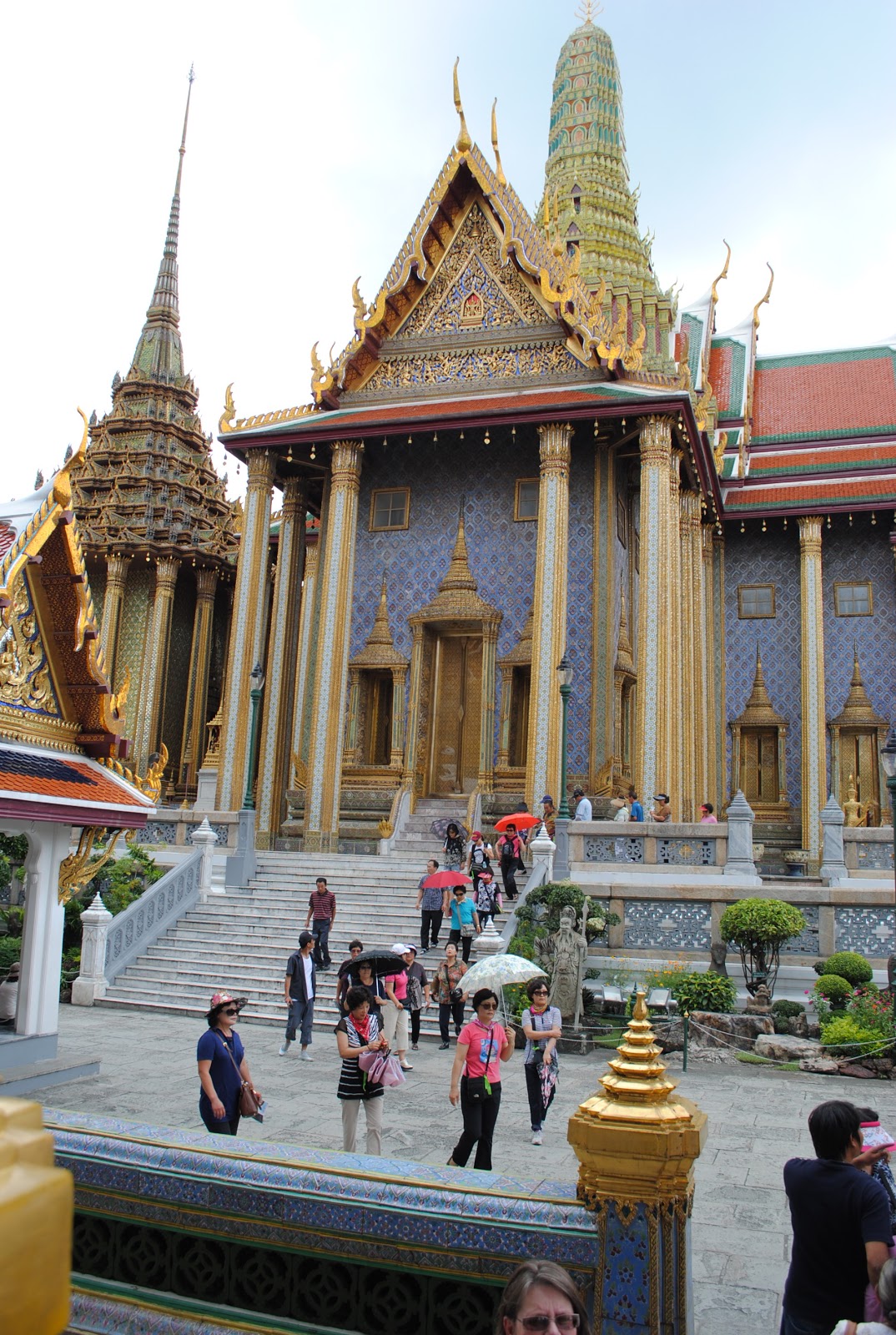
The grounds of Bangkok's Grand Place contains several
wats and chedis.  One is home to the famous Emerald Buddha.


We traveled by water taxi to visit Wat Arunratchawaran in Bangkok
It is more commonly known as Wat Chaeng.
The detailed mosasics adorning this structure are amazing
and include Chinese porcelain as well as glass pieces. 
This prang (spire) is over 70 meters high


The water taxi ride, the view of the eastern bank of the river, and the number of beautiful structures within the compound make Wat Chaeng a must stop for many tourists.


Bangkok's Golden Mount resides within Wat Saket and is actually an artificial hill created by debris from the collapse of an old chedi.  The present structure was added along with spiral staircases.
steps leading up Bangkok's Golden Mount

Still more to climb to reach the temple at the top

view of Bangkok atop the Golden Mount
One of the shrines inside


Even more wat filled than Bangkok, Chiang Mai boasts 33 compounds within the moat surrounding the old city along.  Added to that are 300 plus more  in the surrounding area including Wat Prathat at Doi Suthep,. The 5300 foot elevation is Thailand's second highest peak and that makes this their highest Wat.

306 steps go up to Wat Prathat on Doi Suthep
A tram is available...you pay if you're a tourist
 but the ride is free if you're Thai.
The view of Chiang Mai from Doi Suthep
One of several shrines at Wat Prathat.

  A white elephant carrying a Buddha relic
is said to have laid down and died at this spot
 and a chedi was built to house the relic.
Wat Bupparraram in Chiang Mai is home to a temple structure uniquely built of teak wood and said to be
centuries old.
Beautiful teak wood is the primary material for this wat.

Inside the temple.

The centerpiece of Wat Chedi Luang  is the remains of a 275 foot chedi that was built in 1411 but partially destroyed by an earthquake in 1545.  It is the third oldest structure in Chiang Mai.
At  one time, a large moat surrounded this chedi.

The guardian elephants have disappeared from all but one
side of the chedi.


Wat Pra Singh is one of the largest and most active within the old city of Chiang Mai.  It is so named for the guardian lions adorning the entryway.  They also lend their name to Thailand's most popular beer.
A temple on the grounds of Wat Pra Singh


Many wats will display very realistic wax figures of revered
 deceased monks. One we visited even had mummified remains.

 Near Chiang Rai is the very unique Wat Rong Khun or White Temple.  It is a work in progress begun in 1997 under the sponsorship of internationally renown Thai artist  Chalermchai Kositpitat.  It will take at least another 18 years to finish the project.  A portion of all his income goes to funding construction.   On the day we visited, the artist himself was there, working on the mural in the main temple.  
The breathtaking White Temple near Chiang Rai

To enter the main temple you have to cross this pit of tortured souls

Artwork and statuary both exterior
and interior is beautifully crafted.

A view of the main temple from the adjacent grounds of the wat
You will see a variety of figures and even, of deities as you travel Thailand. Virtually all Buddhist temples have guardian spirits represented by animal figures.  Remember, too that there are Hindu, Chinese and other oriental temples in Thailand that will have an assortment of decor, figures and deities.


Even the smallest villages we visited had their own wats, some of them very ornate.   Religious structures play a very significant role in Thai culture and society.  Taking time to visit and explore them when you travel to Thailand is a worthy investment of time:


Each time we visit a new area, we learn a lot by visiting the local religious institutions.  It gives us a sense of the people who live there and their best aspirations.  More importantly, it serves as a reminder to to be open, courteous and respectful to others as we continue our travels juntos en el camino de la vida.

Saturday, October 29, 2011

On The road of life in Thailand with two great ladies!


The umbrella wasn't for rain, the gals needed some shade!
 I spent a month this fall chris-crossing Thailand, seeing great sites, meeting new people and having the time of my life!

We were joined for two weeks of that adventure by Stephen, our son, and various members of Thoom's Thai family either hosted or joined us for part of those travels.   However, throughout the trip,  two very special ladies were a constant integral part of the experience.

  I owe many thanks to Thoom and Suzanne  for making the trip so enjoyable.   I thought it more than appropriate to share with our blog readers a sampling of photographs of the two of them as we traveled from Bangkok to Chiang Mai to Chiang Rai to Sarakham, Koh Samui and back to Bangkok.
Thoom's Aunt and Uncle
own this restaurant in Bangkok


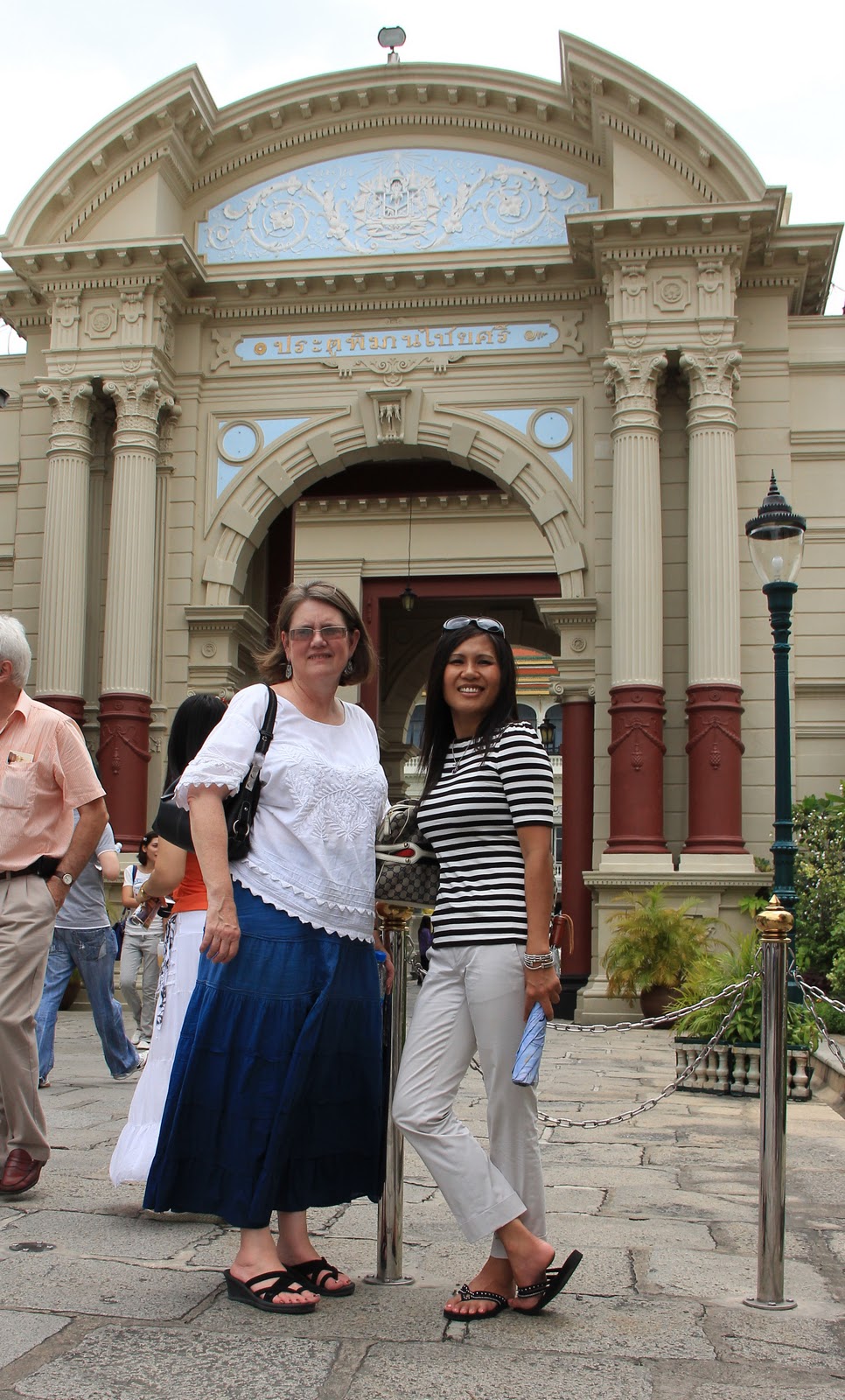
Entering the Grand Palace
Our first tourist outing!

Learning how to hand forge a "singing" alms bowl.

On the way to a water taxi, there's a market, of course!

On the pathway leading up to the Golden Mount


...and this is???
A fan...essential gear!

An overseas call from Steve making sure we are having fun!
One fun one of four monkeys!
See no evil, hear no evil, speak no evil, do no evil!
With Thoom's Mom at The Queen's Gardens near Chiang Mai
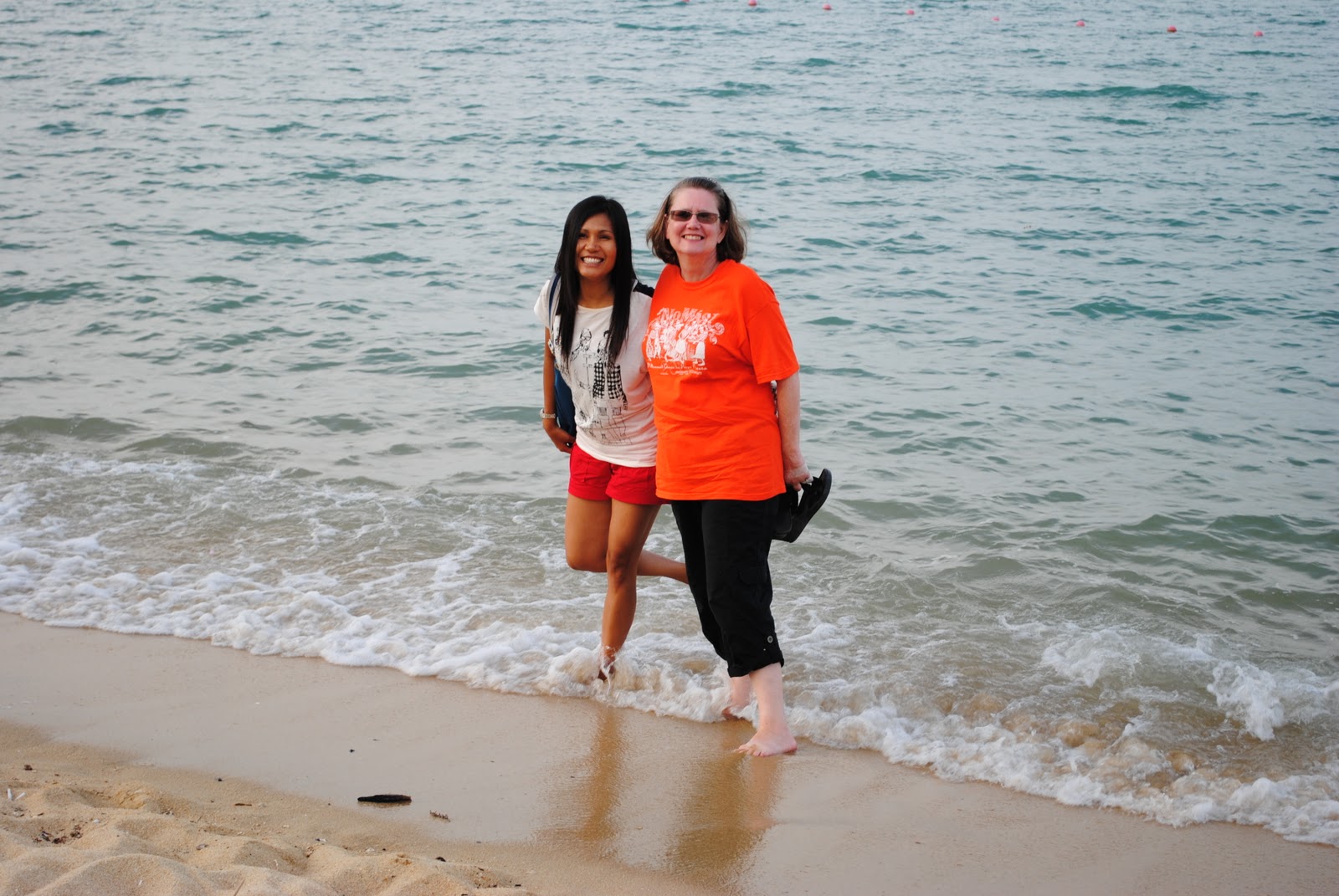
Cooling their heels(literally) on Koh Samui
Steve joins us in Chiang Mai and we have dinner at Chez Marco!

Two bright flowers in the orchid gardens!


How fortunate I was to be accompanied by these two ladies!.  I will never forget the journey we shared in Thailand...juntos en el camino de la vida!